
Every successful electronic product begins with strong hardware and PCB design. From smart consumer devices and industrial automation systems to healthcare equipment and IoT products, a well-designed printed circuit board is essential for delivering reliable performance and long-term durability. An efficient PCB layout helps ensure stable electrical connections, minimizes signal interference, and supports smooth product operation.
Hardware design is more than assembling electronic components. It involves understanding project requirements, selecting the right components, creating detailed schematics, designing optimized PCB layouts, and validating the design through testing and prototyping. Each stage is important to ensure the final product meets quality standards and performs efficiently in real-world applications.
Why is Hardware Design Important?
A robust hardware design offers several advantages:
- Improves product reliability and durability.
- Reduces manufacturing and maintenance costs.
- Enhances electrical performance and efficiency.
- Ensures compliance with industry standards.
- Shortens product development time.
- Simplifies manufacturing and assembly.
Hardware Design Process
1. Requirement Analysis
2. System Architecture
3. Component Selection
4. Circuit Schematic Design
6. Prototype Development
7. Testing and Validation
PCB Design?
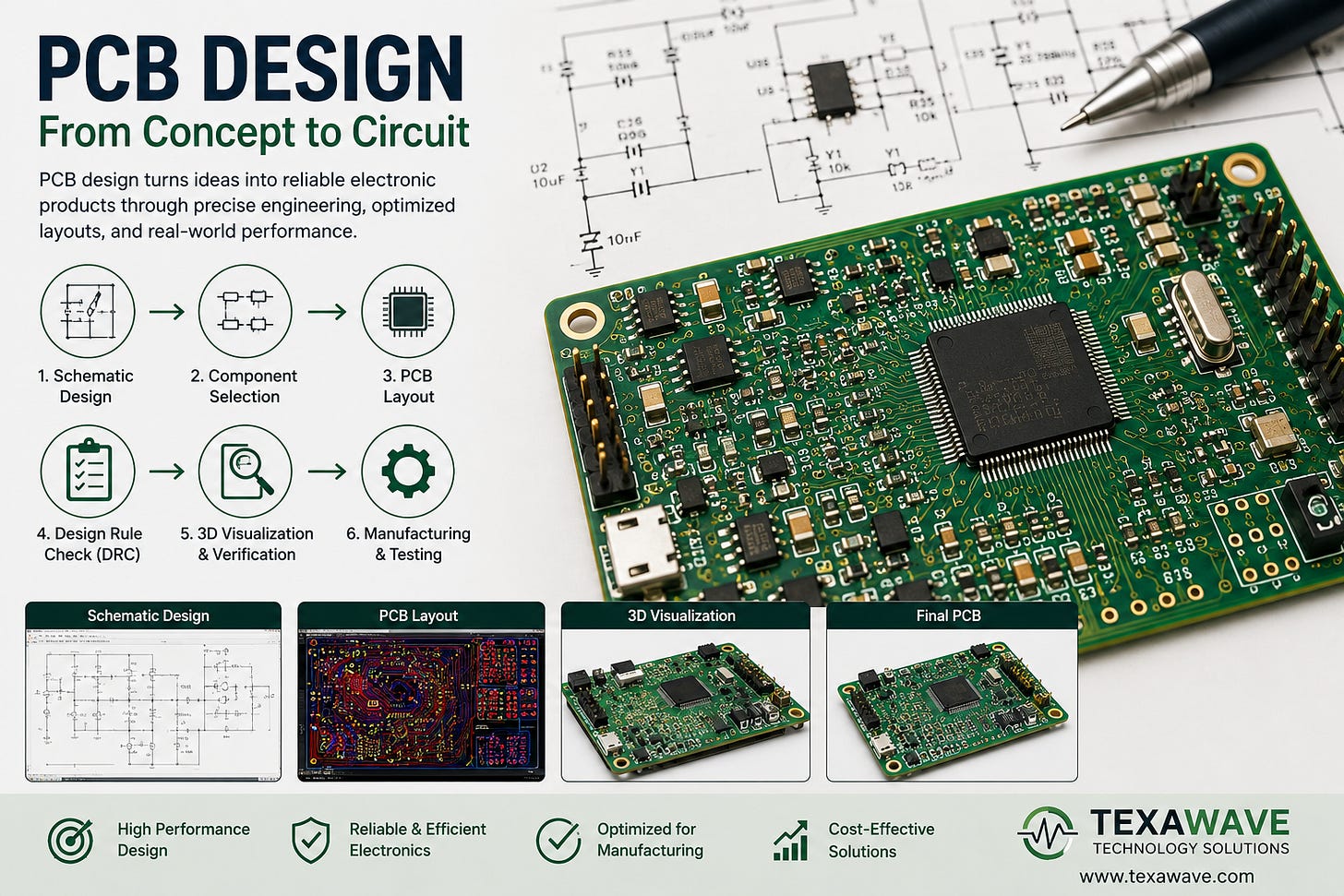
Printed Circuit Board (PCB) design is the process of creating the layout and electrical connections for an electronic circuit on a board. A PCB provides mechanical support and electrical connectivity for electronic components such as resistors, capacitors, integrated circuits (ICs), and connectors. It transforms a circuit schematic into a manufacturable board that ensures reliable performance, efficient signal flow, and ease of assembly.
Types of PCBs
Different applications require different PCB structures. The most common types include:
1. Single-Sided PCB
A single-sided PCB has conductive copper on only one side of the board. Components are mounted on one side, making it the simplest and most cost-effective type of PCB. It is commonly used in calculators, LED lighting, and simple electronic devices.
2. Double-Sided PCB
A double-sided PCB has copper layers on both sides, allowing components and traces to be placed on either side. Vias connect the two layers, enabling more complex circuit designs. These PCBs are widely used in industrial controls, power supplies, and consumer electronics.
A professionally designed PCB improves signal integrity, thermal management, and power efficiency. It also reduces manufacturing errors, lowers production costs, and makes future maintenance easier. As electronic products become more advanced, businesses need scalable hardware solutions that support new technologies while maintaining consistent performance.
At Texawave, we specialize in delivering customized hardware and PCB design solutions for businesses across multiple industries. Our experienced engineers focus on creating optimized circuit designs that improve reliability, simplify manufacturing, and accelerate product development. Whether you require a simple PCB or a complex multilayer board, our team works closely with your requirements to deliver high-quality results.
Frequently Asked Questions (FAQs)
1. What is hardware and PCB design?
Hardware design focuses on developing the electronic circuits and architecture of a product, while PCB design converts those circuits into a physical printed circuit board. Both processes work together to create functional electronic products.
2. Why is PCB layout important?
PCB layout affects electrical performance, signal integrity, thermal behavior, EMI, manufacturability, and reliability. A poor layout can cause problems even when the circuit schematic is correct.
Call to Action
Have a hardware or PCB design project in mind? Let's discuss your requirements and explore the right engineering approach for your product.
Get in touch with our team today to start your hardware and PCB design journey.